What is 3D printing? A practical beginner’s guide
ما هي الطباعة ثلاثية الأبعاد؟ دليل عملي للمبتدئين
By Let’s 3D Studio · 3 min read
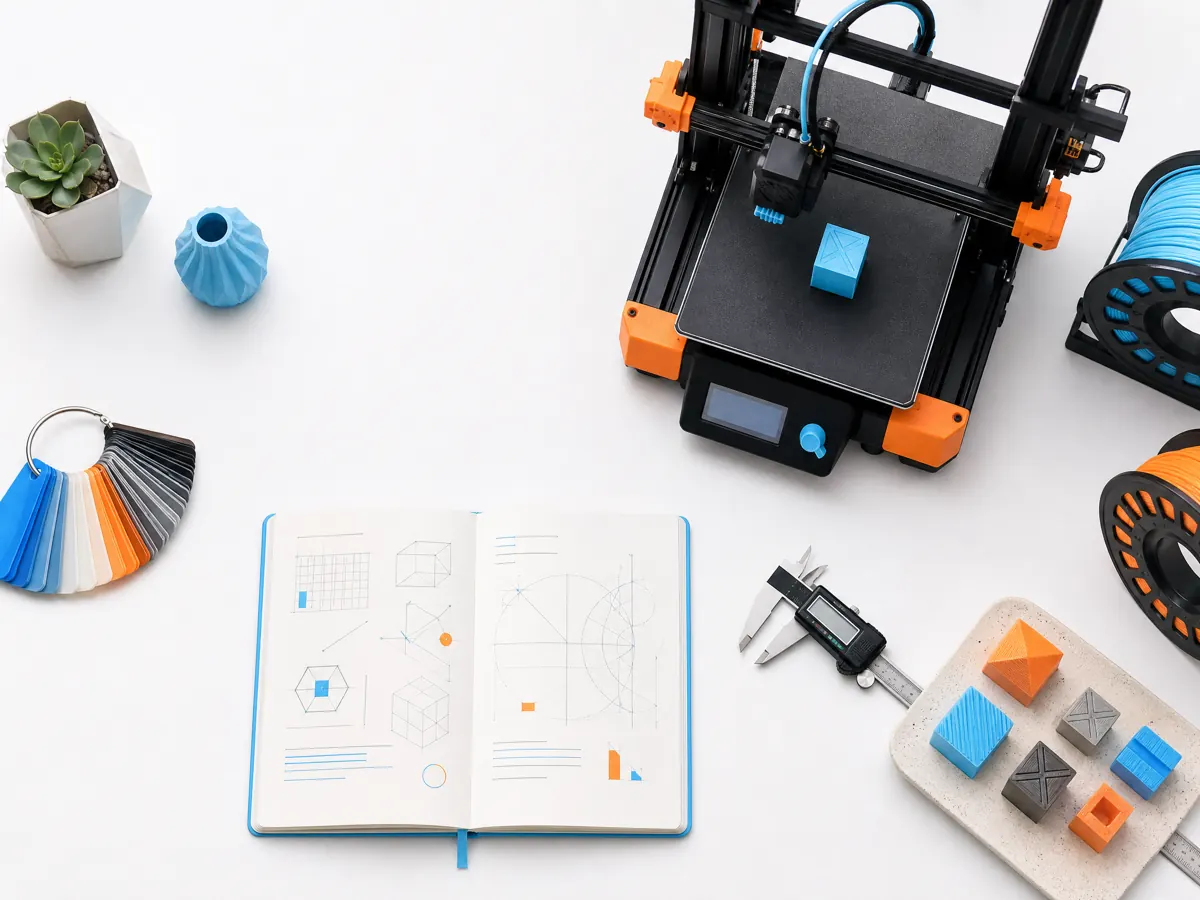
3D printing is a group of additive-manufacturing processes that build an object from a digital model, usually one thin layer at a time. It is useful because it can make a prototype, tool, replacement aid, display form, or custom fixture without first creating a dedicated mold or machining setup. It is not a push-button substitute for design: material, orientation, support, and finishing choices determine whether the object is useful.
The basic workflow
The process begins with a 3D model. You can create one in CAD, obtain one from a source with a license that permits your use, or scan and clean a form where appropriate. The model is then prepared in a slicer. The slicer chooses layers, perimeters, infill, supports, temperatures, speeds, and travel moves that suit a printer and material.
The printer follows that plan. In FDM printing, a heated nozzle deposits thermoplastic filament. In resin printing, light cures liquid photopolymer in selected areas. The finished object may need support removal, washing and curing in a resin workflow, sanding, fitting, or assembly.
What 3D printing is good at
It is especially effective for custom geometry, short runs, prototypes, jigs, enclosures, cable management, fit checks, educational models, and replacement parts that are appropriate to the material and load. It is less efficient for every situation. Large quantities of identical parts, tight metal tolerances, high-temperature service, and regulated or safety-critical components may call for another manufacturing method or professional engineering review.
| Stage | Decision that matters |
|---|---|
| Model | Does the geometry fit the intended load, assembly, and license? |
| Slicing | Are orientation, walls, supports, and temperatures suitable for the material? |
| Printing | Is the plate clean, filament dry, and first layer behaving correctly? |
| Finishing | Does the part need trimming, inserts, fitting, or safe post-processing? |
Materials are part of the design
PLA is often approachable for learning and visual models. PETG can be useful for many tough everyday fixtures. TPU is flexible, while ABS, ASA, nylon, and other engineering materials need more careful control of heat, ventilation, moisture, and printer capability. Select material from the service environment: heat, sunlight, moisture, chemical contact, flexibility, and load all matter.
Resin materials also vary widely. A resin labeled tough, flexible, or engineering-oriented has its own handling, cure, and property limits. Uncured resin requires product-specific protective equipment, ventilation, wash, and waste management. Never treat a resin printer as a general household appliance.
The first print that teaches the most
Start with a small, useful item and observe the first layer. The extruded lines should be connected and gently pressed to the surface, not round and loose or so flat that they are smeared. Save the successful profile with the material and build plate. That record is the beginning of a reliable workflow.
3D printing becomes powerful when you use it to learn from objects. Make a small test, inspect the result, revise the design or profile, and repeat. Each thoughtful iteration turns the printer from a novelty into a practical design tool.