How to choose your first 3D printer without buying the wrong features
كيف تختار أول طابعة ثلاثية الأبعاد من دون شراء ميزات لا تحتاجها
By Let’s 3D Studio · 4 min read
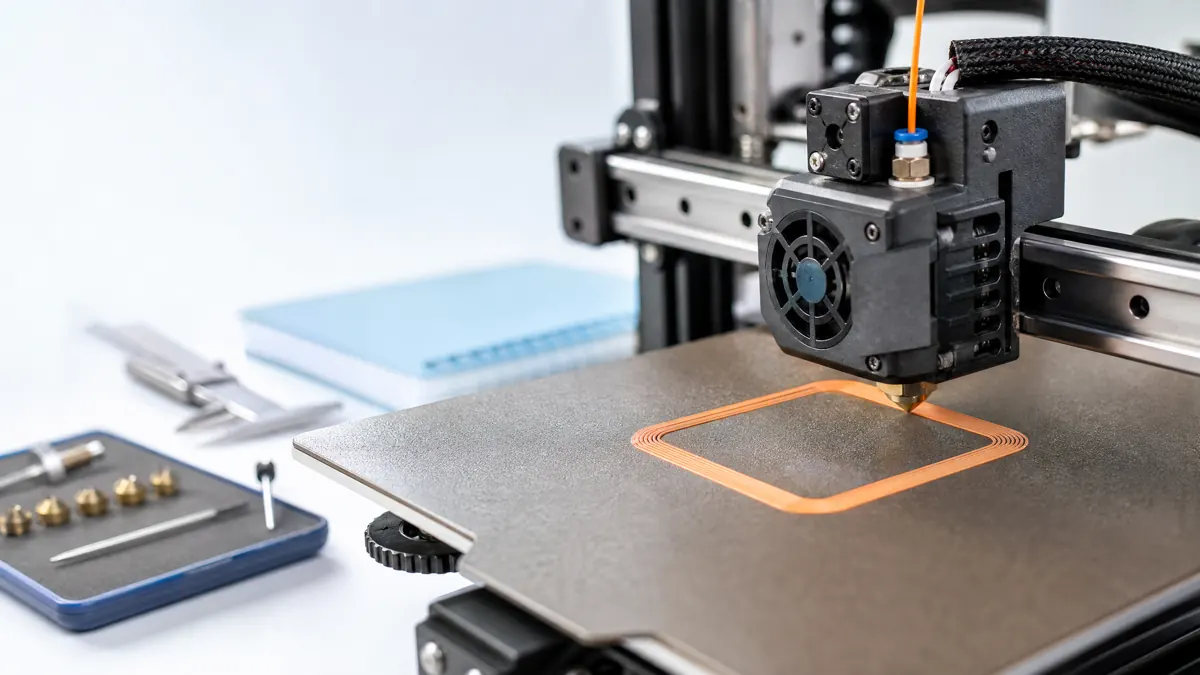
A first printer is easiest to choose when you begin with the objects you intend to make. A compact PLA fixture, a weather-resistant garden clip, a highly detailed miniature, and a flexible gasket each ask for different materials, workspace habits, and machine features. Price and print volume matter, but they are not a substitute for a clear use case.
Start with a three-object brief
Write down three objects you expect to print in the next three months. For each, note its largest dimension, whether it will see heat, moisture, sunlight, load, or food contact, and how much surface detail matters. This simple exercise separates a useful build volume from an aspirational one. A printer that fits your regular objects is usually more valuable than a very large machine that is harder to maintain, heat, and place safely.
Most first-time makers are well served by a dependable FDM printer and PLA. FDM is generally the calmer path for brackets, organizers, prototypes, workshop aids, and learning design. Resin printing can produce fine surface detail, but it requires a dedicated wash-and-cure workflow, personal protective equipment, controlled handling of uncured resin, and appropriate waste disposal. Choose resin because its finish and detail solve a real problem, not because it looks like a universal upgrade.
The machine features that change daily use
An automatic bed-leveling probe can reduce setup friction, but it does not eliminate the need to keep the plate clean or set a sensible first-layer offset. A flexible spring-steel build plate makes many parts easier to remove. A heated bed broadens material options. A direct-drive extruder is often more forgiving with flexible filament, while a Bowden arrangement can be perfectly capable for PLA and PETG when tuned well.
Look for a printer with a clear support path: a current manual, replacement wear parts, a known method for firmware updates, and an active manufacturer or community knowledge base. Consumable nozzles, build plates, belts, and thermistors should be available without importing a whole new machine. Repairability is a feature because a printer is a tool that will eventually need maintenance.
Build volume, enclosure, and materials
Choose build volume from the largest regular part, then add room for a brim or orientation changes. Do not assume a nominal build dimension is fully usable; clips, purge areas, and edge clearance may reduce the practical envelope. A medium desktop machine is often easier to learn on because it warms, calibrates, and stores more easily.
An enclosure is helpful for draft-sensitive materials such as ABS and ASA, but it changes the thermal environment. Electronics, power supplies, and PTFE-lined hotends must remain within the manufacturer’s limits. If your goal is primarily PLA, PETG, and occasional TPU, an open machine in a stable, ventilated area may be the simpler and safer choice. Never choose a high-temperature material before confirming that the hotend, bed, enclosure, and ventilation are rated for it.
| Need | Useful starting priority |
|---|---|
| Organizers, prototypes, learning CAD | Reliable FDM, heated bed, removable plate, PLA support |
| Flexible clips or feet | FDM with a well-supported direct-drive path |
| Outdoor fixtures | FDM plus a material workflow for ASA or suitable PETG, with environmental controls |
| Fine miniatures and small detailed forms | Resin workflow only if you can support safe handling, washing, curing, and disposal |
Budget for the whole workflow
The printer is not the entire purchase. Reserve room for filament, a drying or storage plan, spare nozzles, a scraper or approved removal tool, calipers, cleaning supplies, and a few simple calibration models. A filament runout sensor or camera can be helpful, but a dry spool, clean plate, and observed first layer usually improve results more than another accessory.
Plan a stable location with a nonflammable, level surface, enough clearance for moving axes, and ordinary housekeeping space around the machine. Keep children and pets away from hot surfaces and moving mechanisms. Read the manufacturer’s fire-safety and unattended-operation guidance; a printer should be supervised according to that guidance, especially while you are learning its behavior.
A sensible buying decision
Before ordering, confirm five things: the machine fits your space, its practical build volume fits your three objects, its supported materials match your intended work, parts and documentation are available, and its safety requirements fit your home or studio. Then choose the simplest machine that satisfies those conditions. A predictable first printer teaches more than a feature-heavy machine whose settings, materials, and repairs exceed your current workflow.
Your first success should be modest: a well-fitting calibration part, a labeled storage tray, or a simple tool holder. Record the material, plate, layer height, and first-layer result. That record turns a purchase into a repeatable making practice.